Concealed Hinge or Ball Bearing Hinge: Which Should You Use?
Updated 2026-11-05 · RAYEN 雷茵
What is the difference?
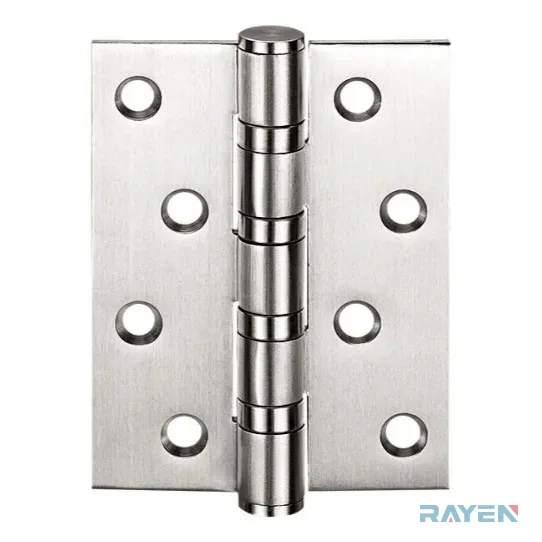
A ball bearing hinge is a butt hinge. Two flat leaves meet at a knuckle, and that knuckle stays visible on the pull side of the door. The leaf sits in a recess as deep as its own thickness, which in our range is 2.5mm to 4mm.
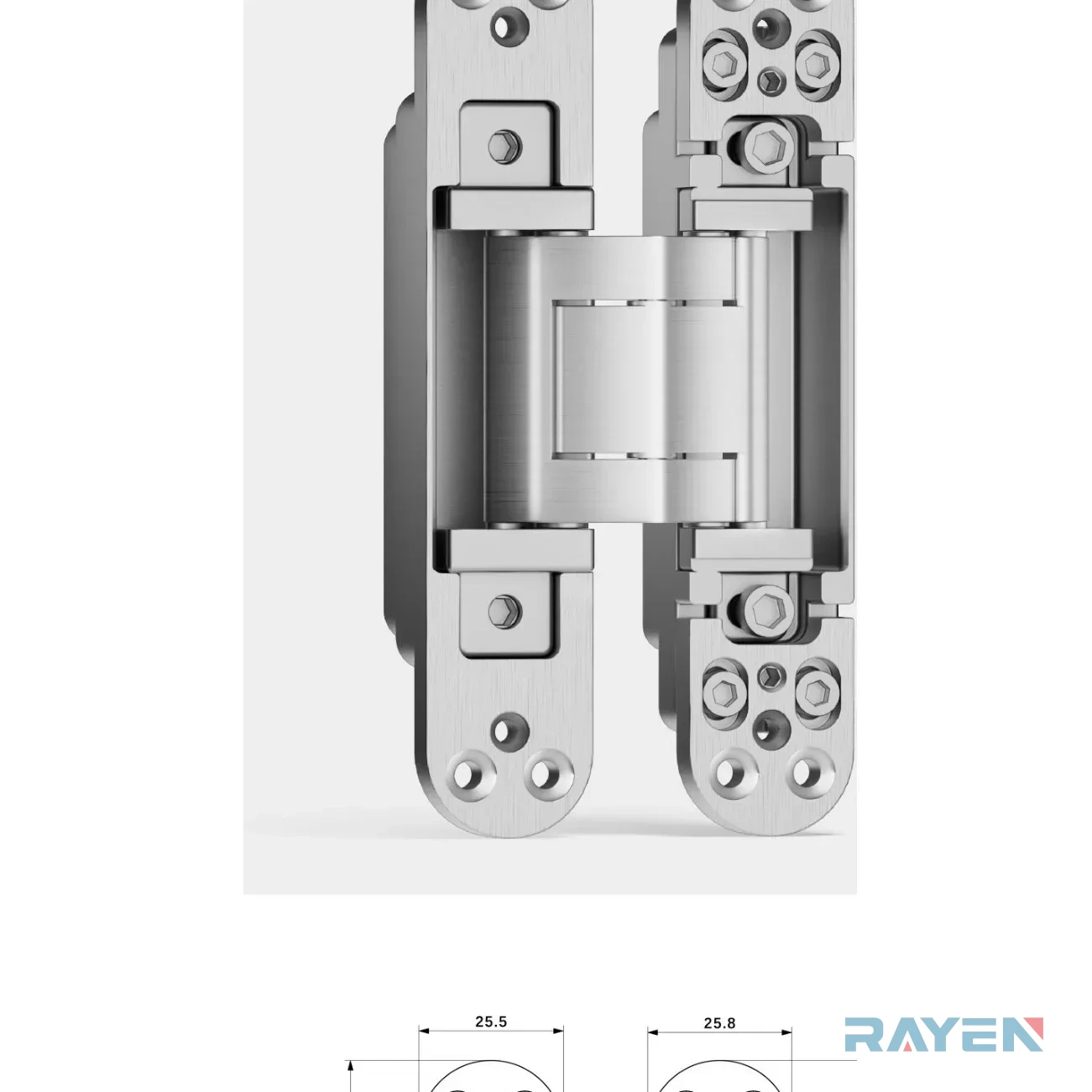
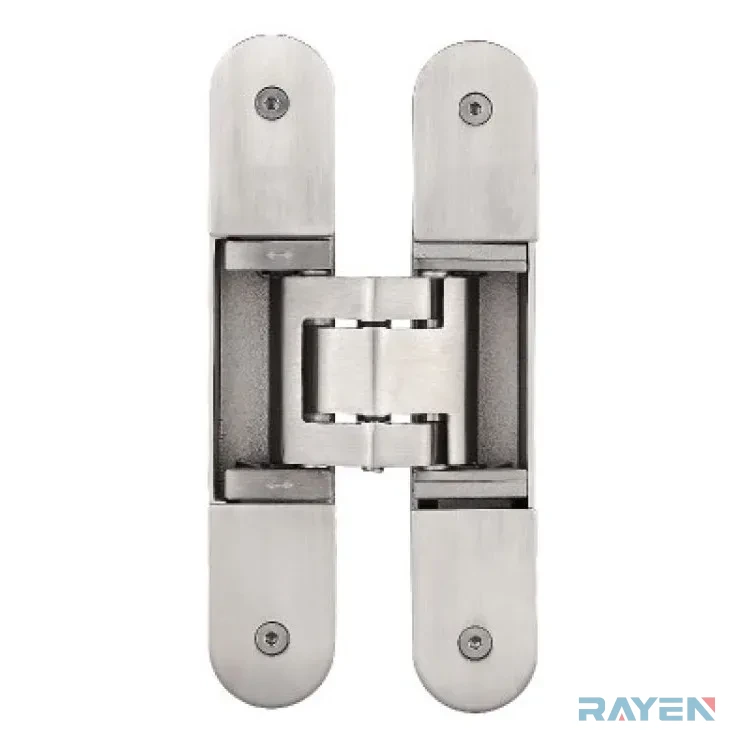
A concealed hinge folds inside the door. Its body sits in a pocket in the door edge and another in the frame. With the door closed you see nothing. With the door open you see the linkage.
What should you check on your door?
- Door thickness at the hinge edge.
- Door weight.
- Frame: how deep can you route without weakening it?
- Whether the hinge may show.
- Whether the door will need adjustment after hanging.
- Who fits it. Does the fitter have a router and a jig?
How do they compare?
- Cut in the door: 4x3x3.0-4BB needs a 3mm recess. RY100 needs routing 10mm and 30mm deep, and R-CS100 needs 12mm and 50mm.
- Door thickness: ball bearing hinges list none. Concealed hinges list a minimum, from 20mm on R-CS30 to 62mm on R-CC300.
- Load: ball bearing hinges list no load figure. Concealed hinges list 30kg to 200kg on two hinges.
- Adjustment: a plain ball bearing hinge has none. Most RY and R-CC models adjust in three directions.
- Materials: ball bearing hinges come in stainless steel or brass. Concealed hinges come in stainless steel or zinc alloy.
- Opening: the R-series concealed models open to 180°. For a butt hinge, the opening depends on the door and frame.
How much can you adjust a concealed hinge?
| Model | Adjustment | Maximum load capacity (2 hinges) | Minimum door thickness |
|---|---|---|---|
| RY80 | Up and down: ±1.5mm; Front and back: ±1.5mm | 80kg | 38mm |
| RY80J | Up and down: ±2.5mm; Left and right: ±2.0mm; Front and back: ±2.5mm | 80kg | 40mm |
| RY100 | Up and down: ±3.0mm; Left and right: ±2.0mm; Front and back: ±1.0mm | 100kg | 33mm |
| RY150 | Up and down: ±3.0mm; Left and right: ±2.0mm; Front and back: ±1.0mm | 100kg | 33mm |
| R-CC120J | Up and down: ±3.0mm; Left and right: +3.5/-2.0mm; Front and back: ±1.5mm | 120kg | 40mm |
| R-CF120 | Up and down: ±3.0mm; Left and right: +3.5/-2.0mm; Front and back: ±1.5mm | 120kg | 40mm |
| RY120 | Up and down: ±3.0mm; Left and right: +3.5/-2.0mm; Front and back: ±1.5mm | 120kg | 40mm |
| RY140 | Up and down: ±2.5mm; Left and right: ±1.5mm; Front and back: ±1.0mm | 120kg | 40mm |
| RY177 | Up and down: ±3.0mm; Left and right: ±3.0mm; Front and back: ±1.0mm | 120kg | 38mm |
| R-CC200 | Up and down: ±3.0mm; Left and right: ±3.0mm; Front and back: ±1.0mm | 200kg | 45mm |
| R-CC200J | Up and down: ±3.0mm; Left and right: ±2.0mm; Front and back: ±2.0mm | 200kg | 48mm |
| R-CC300 | Up and down: ±3.0mm; Left and right: ±2.0mm; Front and back: ±2.0mm | 200kg | 62mm |
This is often the deciding point. On a run of doors, up to ±3.0mm up and down saves you from rehanging a door that came out a little low. The R-CS models list no adjustment, so they need an exact cut. RY80 adjusts in two directions only.
Not every door needs that. If your fitters cut clean recesses every day, a butt hinge is quick to hang and easy to replace later. Lift the old one out, and the new one drops into the same recess if the leaf size matches.
Ball bearing hinge sizes to start from
| Model | Leaf size | Thickness | Bearings | Material |
|---|---|---|---|---|
| 3x2.5x2.5-2BB | 76.2 × 63.5mm | 2.5mm | 2 × ball bearing | Stainless Steel (304/201) |
| 3x3x2.5-2BB Rounded | 76.2 × 76.2mm | 2.5mm | 2 × ball bearing | Stainless Steel (304/201) |
| 4x3x2.5-2BB Centre Pivot | 100 × 75mm | 2.5mm | 2 × ball bearing | Stainless Steel (304/201) |
| 4x3x2.5-2BB Offset Pivot | 100 × 73mm | 2.5mm | 2 × ball bearing | Stainless Steel (304/201) |
| 4x3x3.0-0BB | 100 × 70mm | 3mm | 0 × ball bearing | Brass |
| 4x3x3.0-2BB Offset Pivot | 100 × 75mm | 3mm | 2 × ball bearing | Stainless Steel (304/201) |
| 4x3x3.3-2BB | 100 × 79mm | 3.3mm | 2 × ball bearing | Brass |
| 100x75x3.0-0BB Pull | 100 × 75mm | 3mm | 0 × ball bearing | Stainless Steel (304/201) |
| 100x89x3.0-1BB | 100 × 89mm | 3mm | 1 × ball bearing | Stainless Steel (304/201) |
| 4x3.5x3.0-2BB US | 101.6 × 89mm | 3mm | 2 × ball bearing | Stainless Steel (304/201) |
| 4x3.5x3.0-4BB | 101.6 × 89mm | 3mm | 4 × ball bearing | Stainless Steel (304/201) / Brass |
| 4x3.5x3.0-4BB US | 101.6 × 89mm | 3mm | 4 × ball bearing | Stainless Steel (304/201) |
These are the shortest leaves. The ball bearing hinge size chart has every model, up to 203.2 × 101.6mm.
Is there something in between?
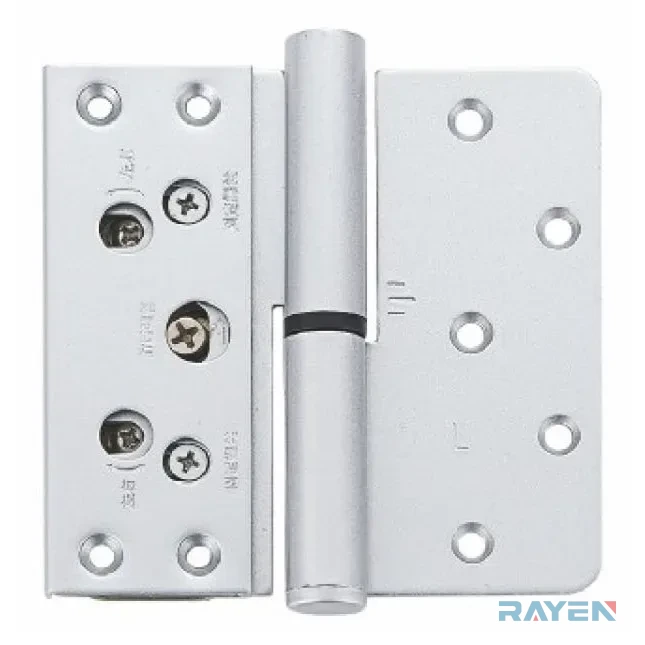
Yes. 4x4x2.5-3D is a butt hinge with adjustment built in. Its leaf is 103 × 102mm and 2.5mm thick, in iron and zinc alloy, with a 15mm knuckle width. The photos show adjusting screws on the leaf, marked for each direction. The barrel stays visible, but you can correct the door after hanging. The adjustment range is not printed, so confirm it with us if you are working to a tolerance.
Need a door that also closes itself? Concealed hydraulic hinges do both. See hydraulic hinge types.
Two worked examples
A hotel room door
It is a 45mm timber door at 60kg, and the design calls for flush, clean edges. RY100 fits: 100kg on two hinges, door of 33mm or more, ±3.0mm up and down. The margin covers later changes to the door. Check that the frame can take a 30mm pocket.
A replacement run in an old building
The frames are already cut for a 4 inch by 3 inch butt hinge, and the existing leaves measure 101.6 × 76.2mm. 4x3x3.0-4BB drops in with no new routing, if the screw holes line up. A concealed hinge would mean filling the old recess and cutting two new pockets.
What about metal frames?
Look at the routing depth first. A concealed hinge needs its pocket in the frame as well as in the door, and R-CC200 goes as deep as 45.5mm. Hollow metal frames may not offer that. Send us a frame section and we check the depth against the drawing.
What should you write on the order?
For a ball bearing hinge:
- Full code, material with grade, leaf size in mm, finish, quantity.
For a concealed hinge:
- Model, door weight, thickness and width, frame material, hinges per door, finish, quantity.
Send one door drawing and we check either choice against it.
Open the selection tool:Concealed Hinge Selector
Questions buyers ask
Are concealed hinges stronger than ball bearing hinges?
We cannot compare the two on one number, because only concealed hinges carry a printed load. Send the door weight and we confirm the right model of either type.
Can I swap ball bearing hinges for concealed hinges on an existing door?
Only with new routing in the door and the frame, and the door has to meet the model's minimum thickness. The old recess also has to be filled.
Which type is easier to replace later?
A butt hinge. If the leaf size and screw holes match, the new one goes straight into the old recess. Keep the model code with your project records.