D Pull or Bar Pull Handle: How to Tell Them Apart and Which to Choose
Updated 2026-11-09 · RAYEN 雷茵
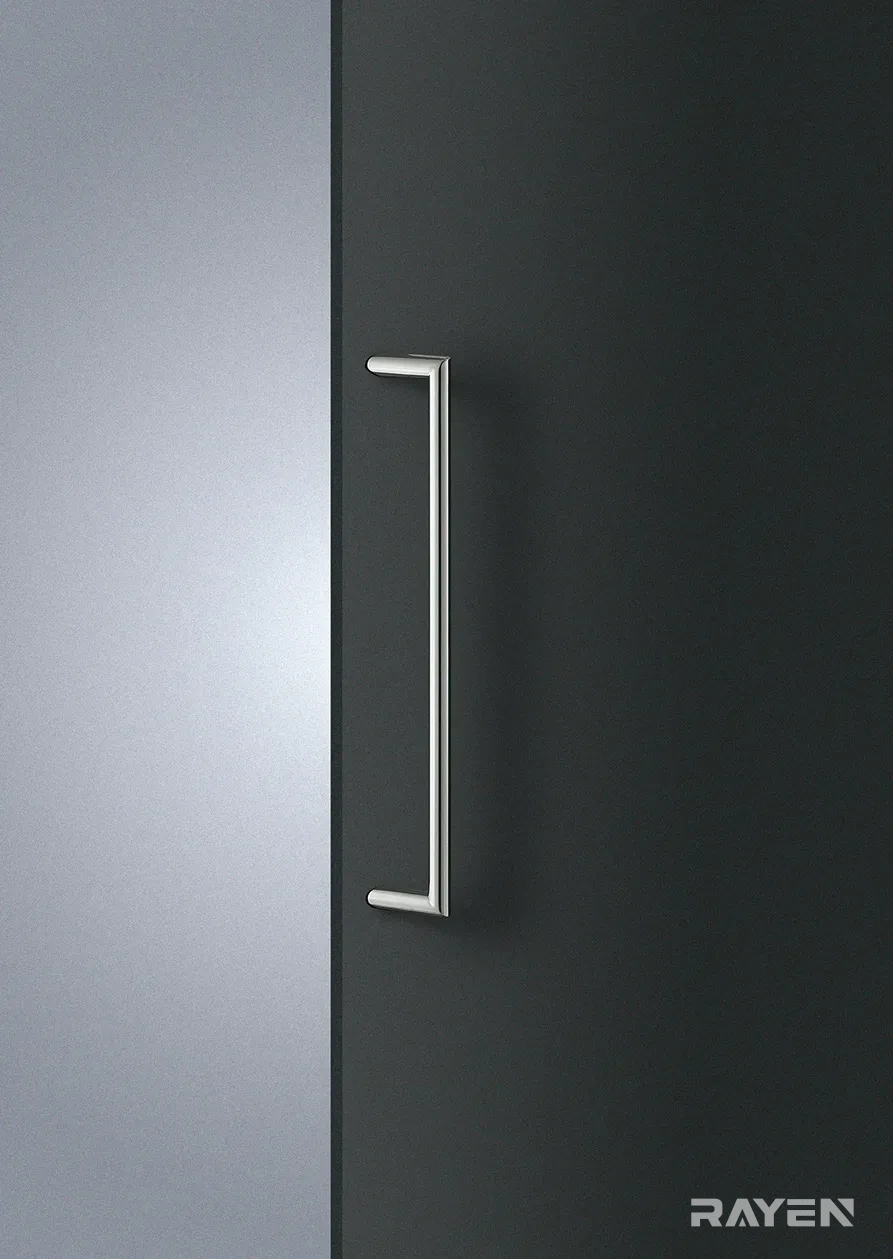
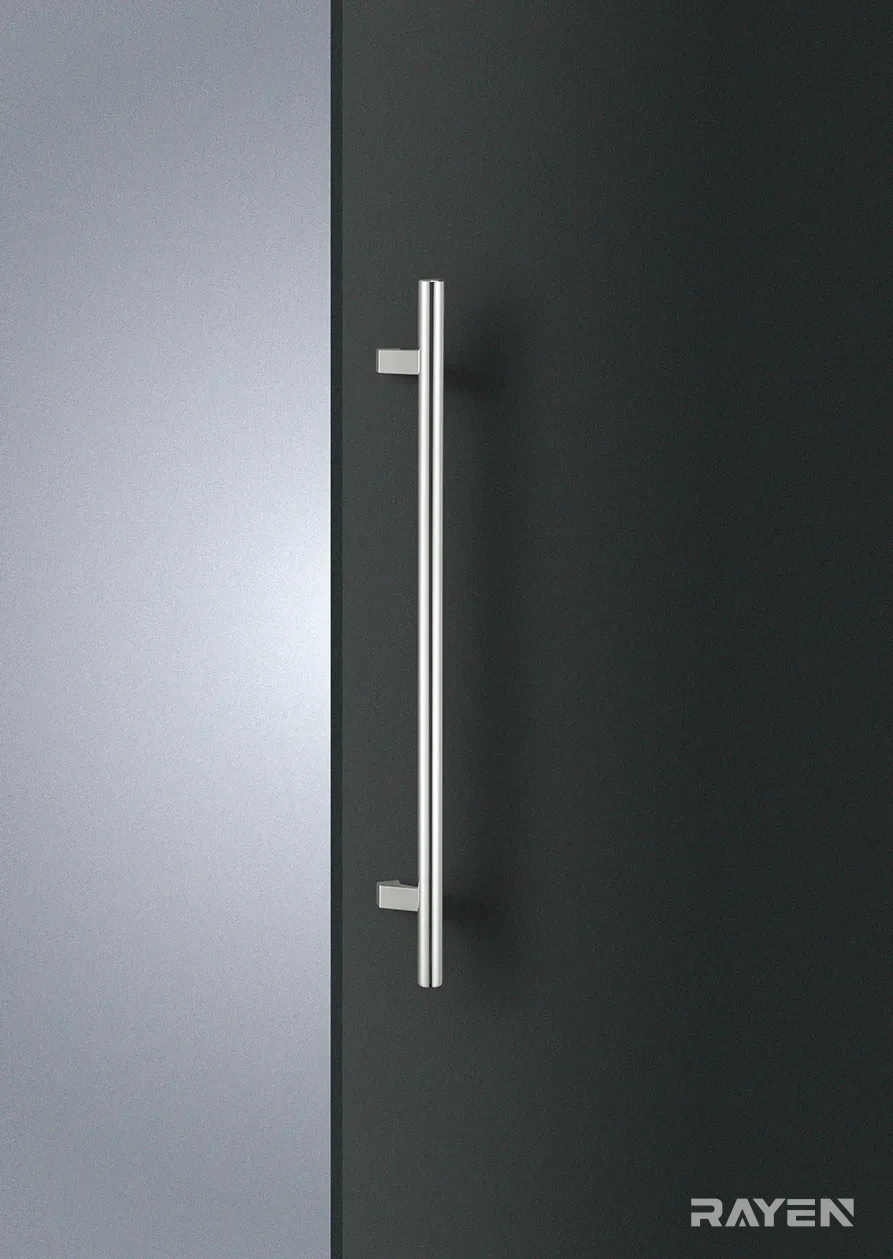
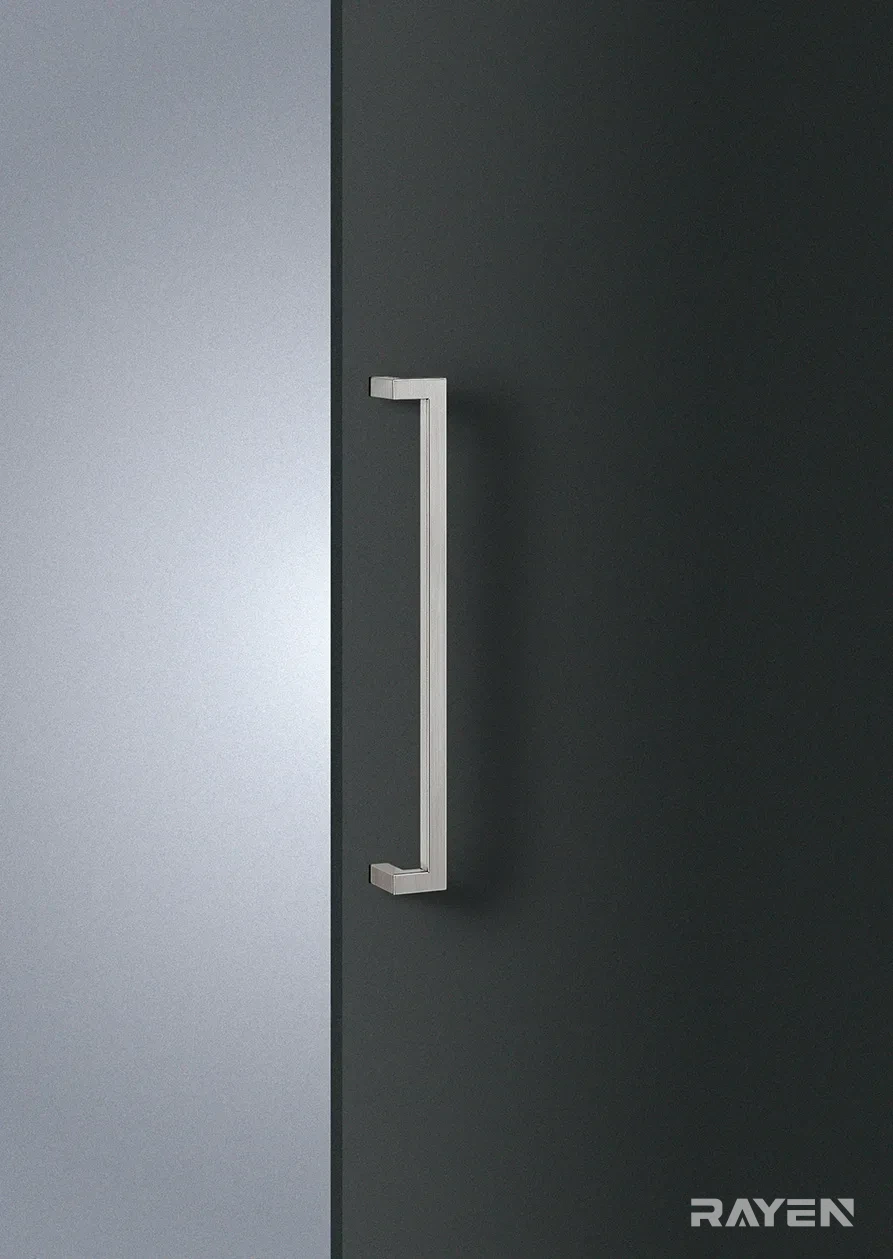
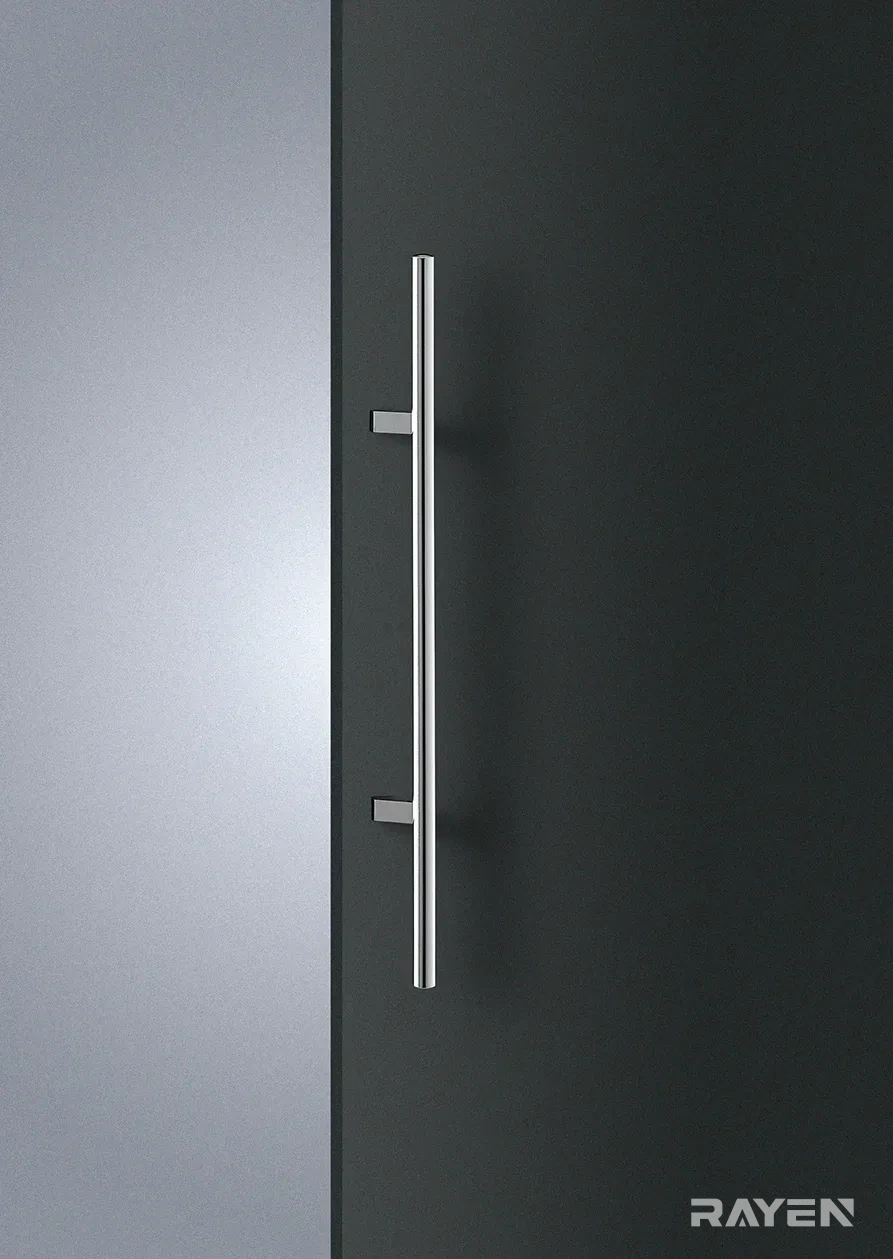
Buyers often order by length and are surprised by the shape that arrives. Two handles with the same holes can be 175mm apart in length. This guide shows how to read the shape from the numbers in our door pull handles, before you see a photograph.
How do you tell a D pull from a bar pull?
Take the overall length, subtract the centre distance, and compare the answer with the bar size.
- If the difference equals the bar, the feet sit at the ends. That is a D pull.
- If the difference is much larger, the bar runs past the feet. That is a bar pull, also called a T-bar or ladder pull.
Worked examples from our range:
- T1121: 550mm long, P=528mm, 22mm bar. Difference 22mm. D pull.
- T1263: 600mm long, P=578mm, 22mm bar. D pull.
- T3008: 600mm long, P=568mm, 32mm bar. D pull.
- T1170: 600mm long, P=425mm, Ø27mm bar. Difference 175mm. Bar pull.
- T720: 800mm long, P=425mm, 25mm bar. Difference 375mm. Bar pull with a long overhang.
The photographs confirm each one. Use the rule to sort a long list quickly, then check the drawing.
Same holes, different shape
T2640 and T1170 both list P=425mm. One is a 450mm D pull, the other a 600mm bar. Both fit the same two holes, so on a refurbishment you can change the look without new drilling, as long as the screw matches: T2640 uses M8, T1170 M6. Our guide to back-to-back pull handle fixing gives the hole for each.
Pull handles from the shortest up
| Model | Overall length | Centre distance | Grip section | Projection |
|---|---|---|---|---|
| T5580 | 250mm | P=223mm | — | 60mm (L250) / 65mm (L400) |
| MTR2110 | 300mm | P=284mm | — | 60mm |
| T1172 | 300mm / 450mm / 600mm | P=275mm (L300) / P=425mm (L450) / P=575mm (L600) | 25 × 25mm (square) | 65mm |
| T580 | 400mm | P=250mm | 22mm | 62mm |
| T790 | 400mm / 600mm / 800mm | P=360mm (L400) / P=560mm (L600) / P=760mm (L800) | 25mm | 60mm |
| T685 | 443mm / 748mm | P=425mm (L443) / P=730mm (L748) | 40 × 18mm | 70mm |
| T1170 | 450mm / 600mm / 750mm | P=275mm (L450) / P=425mm (L600) / P=575mm (L750) | Ø27mm | 60.4mm |
| T2640 | 450mm / 600mm | P=425mm (L450) / P=575mm (L600) | Ø25mm | 60mm |
| T2750 | 452mm | P=425mm | — | 67mm |
| T2083 | 490mm | P=450mm | 30mm | 90mm |
| T1050 | 500mm | P=473mm | 25mm | 53.1mm |
| T1550 | 500mm / 750mm | P=475mm (L500) / P=725mm (L750) | — | 60mm |
| T915 | 515mm | P=330mm | — | 82mm |
| T2051 | 527mm | P=500mm | — | 70mm |
| T25 | 550mm | P=425mm | 25mm / 22mm | 67mm / 63mm |
| T1121 | 550mm | P=528mm | 22mm | 63mm |
| T812 | 565mm | P=425mm | — | 118.5mm |
| T52 | 600mm / 1200mm | P=425mm (L600) / P=800mm (L1200) | 25mm | 65mm |
| T620 | 600mm / 800mm | P=425mm | 25mm | 60mm |
| T1138 | 600mm / 1640–2140mm | P=425mm (L600) / P=1640–2140mm (L1640–2140) | Ø35mm | 67.5mm (L600) / 65mm (L1640–2140) |
| T1216 | 600mm | 425mm | 25.6mm, kidney section | 57.2mm |
| T1224 | 600mm | P=540mm | 25mm | 51.5mm |
| T1225 | 600mm | P=507mm | 25mm | 42mm |
| T1255 | 600mm | P=500mm | 25mm | 60mm |
| T1263 | 600mm | P=578mm | 22mm | 52mm |
| T1265 | 600mm | P=574mm | 35mm | 55mm |
| T1266 | 600mm | P=540mm | — | 50mm |
| T1270 | 600mm | P=425mm | 25mm | 60mm |
| T2690 | 600mm | P=500mm | Ø22mm | 71mm |
| T2930 | 600mm | P=425mm | 25mm | 65mm |
When should you choose a D pull?
- The door edge or a frame is close to the handle line. A D pull has nothing past its feet to hit a wall, a return or the other leaf.
- The handle must look compact: a cubicle door, a cabinet-height door, a narrow stile.
- The door is glass and the holes are near the edge. Fewer centimetres of bar near the edge is easier to place.
- You want the length to be predictable from the holes. On a D pull it always is: P plus the bar.
When should you choose a bar pull?
- You want a long vertical line on the door but only two holes.
- The hand may come from above or below. A bar pull lets a tall and a short person both find the grip.
- You are matching a push plate or a long lever plate on the same door and want the handle to read as long.
- The door is wide and the handle sits well away from the edge, so the overhang has room.
For entrance doors that need a very long line, a bar pull with intermediate feet is usual; see long entrance door pull handles.
Does the shape change the fitting?
No. Both types fix through a hole at each foot with the same screws and hole sizes. What changes is where the metal sits relative to the door edge, and how far the hand travels to the grip. Check projection either way: our handles list it model by model, and the size chart explains how it is measured.
What to write on your order
Write the shape alongside the numbers so nobody guesses: T2640, D pull, 450mm long, P=425mm, Ø25mm, M8, satin stainless. Or T1170, bar pull, 600mm long, P=425mm, Ø27mm, M6.
Next step
Not sure which shape suits the door? Send the door elevation with the handle position to [email protected], or try both shapes on your holes with the pull handle finder. For a sample of each, message the factory owner on WhatsApp from the contact page.
Open the selection tool:Pull Handle Finder by Centre Distance
Questions buyers ask
What is the difference between a D pull and a bar pull handle?
A D pull has its feet at the ends; a bar pull runs past its feet. On a D pull, length minus centre distance equals the bar size.
Can a D pull and a bar pull use the same holes?
Yes, if the centre distance and screw match. T2640 and T1170 both have P=425mm, with M8 and M6 screws.
Which is better near a door edge?
A D pull, because nothing extends past its feet towards the edge or the next leaf.